
Faith and Fellowship Category
How the Gospel Elevated the Dignity of Women in the Ancient World
By Rev. Richard Dalton
Creator of JesusQuestion.com and LookUpDetroit.com
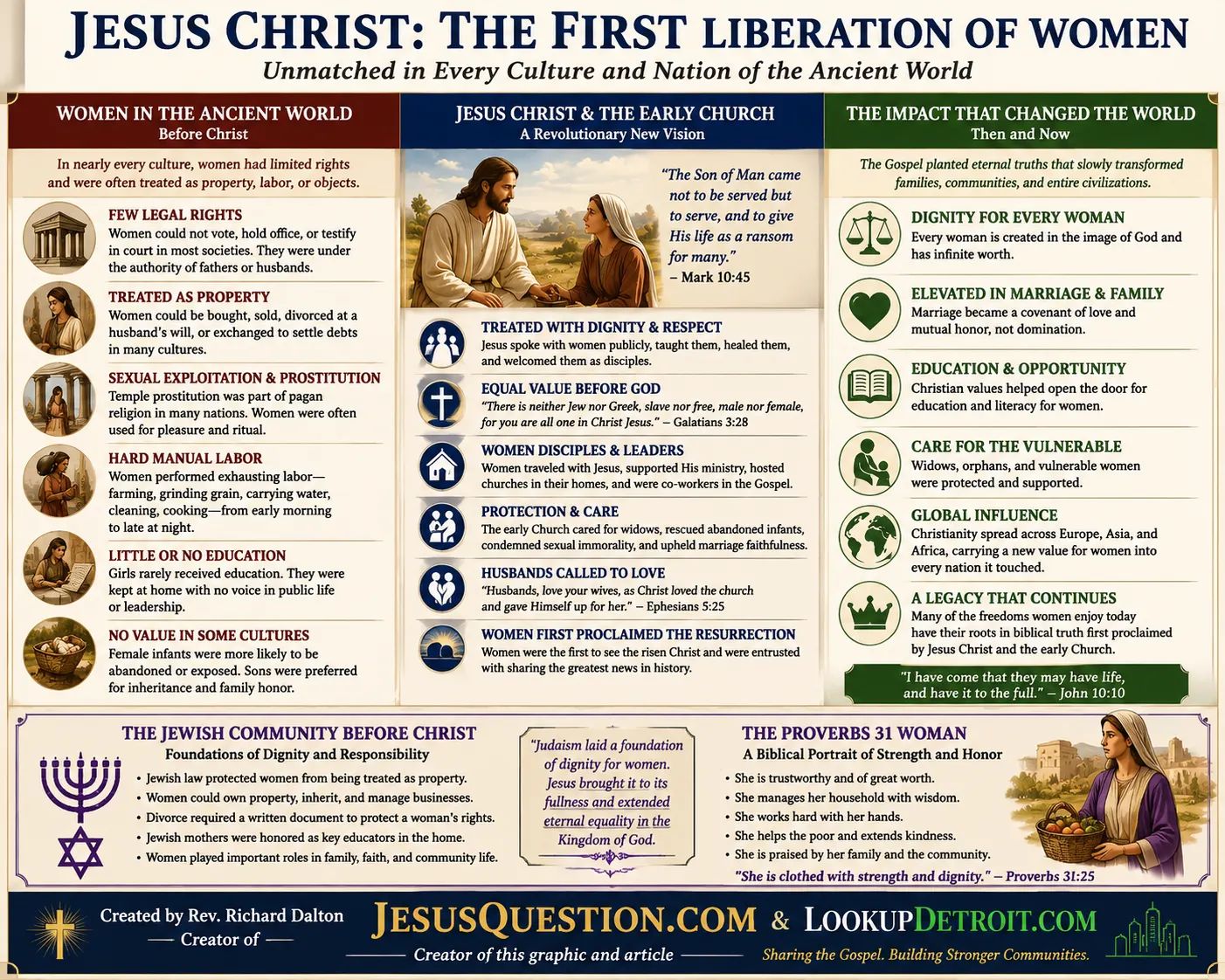
When people speak of liberation movements, they often think of the last two hundred years. Yet nearly two thousand years ago, Jesus Christ introduced a view of women that stood in remarkable contrast to much of the ancient world. Without armies, political revolutions, or government mandates, Christ and the early Church planted truths that slowly transformed families, communities, and eventually entire civilizations.
This was not merely a change in social customs. It was a revolution rooted in the belief that every human being—male and female—is created in the image of God and possesses immeasurable worth.
The Ancient World Before Christ
The civilizations surrounding Israel—Greek, Roman, Egyptian, Persian, and many pagan cultures—produced extraordinary achievements in architecture, philosophy, and government. Yet women generally occupied a much lower position than men.
Although conditions varied from place to place, women commonly faced restrictions that included:
- Limited legal rights.
- Dependence upon fathers or husbands.
- Little opportunity for education.
- Heavy domestic and manual labor.
- Exploitation through slavery and prostitution.
- Little public influence or legal protection.
Some cultures practiced female infanticide by abandoning unwanted baby girls. Others viewed women largely through the lenses of labor, inheritance, or pleasure rather than personal dignity.
The Bible never suggests that all ancient societies treated women identically, but history makes clear that women seldom enjoyed equal honor or protection.
The Jewish Foundation
Long before Christ, the Hebrew Scriptures had already laid an important foundation.
Unlike many surrounding cultures, Jewish law recognized women as persons under God’s covenant rather than mere property.
Women could:
- Inherit property in certain circumstances.
- Own possessions.
- Receive legal protections in marriage.
- Be honored as mothers and teachers within the home.
One of the greatest portraits of womanhood in all ancient literature appears in Proverbs 31. Far from depicting a passive individual, the Proverbs 31 woman manages a household, buys land, conducts business, helps the poor, teaches wisdom, and earns the praise of her family.
Judaism established principles of dignity that prepared the way for the fuller revelation that would come through Jesus Christ.
Jesus Changed the Conversation
The Gospels repeatedly show Jesus treating women with unusual respect for His day.
He publicly spoke with women despite cultural criticism.
He welcomed women among His followers.
He healed women.
He defended women from public humiliation.
He accepted their financial support for His ministry.
He taught them directly rather than excluding them from spiritual instruction.
Women were not merely spectators. They became disciples.
The Samaritan woman became one of the first evangelists after meeting Christ at Jacob’s well.
Mary of Bethany was commended for sitting at Jesus’ feet as a learner—a position normally reserved for male disciples.
Jesus protected the woman caught in adultery from a mob ready to stone her, calling both justice and mercy into view.
Again and again, Christ treated women as individuals created by God rather than as social possessions.
Equal Value Before God
One of Christianity’s most revolutionary declarations appears in Galatians 3:28:
“There is neither Jew nor Greek, slave nor free, male nor female, for you are all one in Christ Jesus.”
Paul was not erasing the distinctions between men and women. Rather, he proclaimed that every believer possesses equal standing before God through faith in Jesus Christ.
In a world divided by class, ethnicity, slavery, and gender, this was extraordinary.
Women in the Early Church
The New Testament presents women serving in significant ways.
Women opened their homes for churches.
They supported missionary work.
They instructed younger believers.
They cared for widows and the poor.
Several are specifically named as faithful co-workers in the spread of the Gospel.
Perhaps most remarkably, God entrusted women with the greatest announcement in history.
On Easter morning, women became the first witnesses of Christ’s resurrection and the first commissioned to tell the apostles that Jesus was alive.
In a culture where female testimony was often discounted, God deliberately chose women to proclaim the central truth of Christianity.
Marriage Transformed
Christianity also transformed marriage.
Instead of teaching domination, Scripture commands husbands:
“Husbands, love your wives, just as Christ loved the church and gave Himself up for her.” (Ephesians 5:25)
The model became sacrificial love rather than selfish authority.
Marriage was elevated into a lifelong covenant marked by mutual honor, faithfulness, and care.
While Christians have not always lived up to these ideals, the ideals themselves profoundly influenced Western civilization.
A Slow but Lasting Influence
The Gospel did not instantly erase every injustice.
Transformation occurred gradually as Christian beliefs spread through families, churches, schools, hospitals, and communities.
Over centuries Christianity encouraged:
- Greater respect for marriage.
- Care for widows and orphans.
- Protection of abandoned infants.
- Expansion of education for girls.
- The founding of hospitals and charitable ministries.
- Recognition of women’s spiritual gifts and service.
Many freedoms enjoyed by women in large parts of the world today developed within cultures deeply shaped by biblical Christianity.
An Honest Historical Perspective
History should also be approached honestly.
Not every society before Christ treated women identically.
Some women in Greece, Rome, Egypt, and elsewhere held influence, wealth, or political power. Likewise, Christians throughout history have sometimes failed to live consistently with Christ’s teachings.
Yet the remarkable fact remains that Jesus introduced principles of human dignity that challenged many accepted assumptions of the ancient world.
His teaching elevated women not by political revolution but by transforming hearts, families, and communities.
The Continuing Message
The Christian understanding of human dignity begins with a simple truth:
Every person is created by God.
Every life possesses eternal value.
Every woman bears God’s image.
That conviction continues to shape societies wherever the Gospel is believed and practiced.
Jesus summarized His mission this way:
“I have come that they may have life, and have it abundantly.” (John 10:10)
That abundant life extends to men and women alike. The dignity, honor, and hope Christ offered in the first century continue to inspire millions around the world today.
Rev. Richard Dalton
Creator of JesusQuestion.com and LookUpDetroit.com
