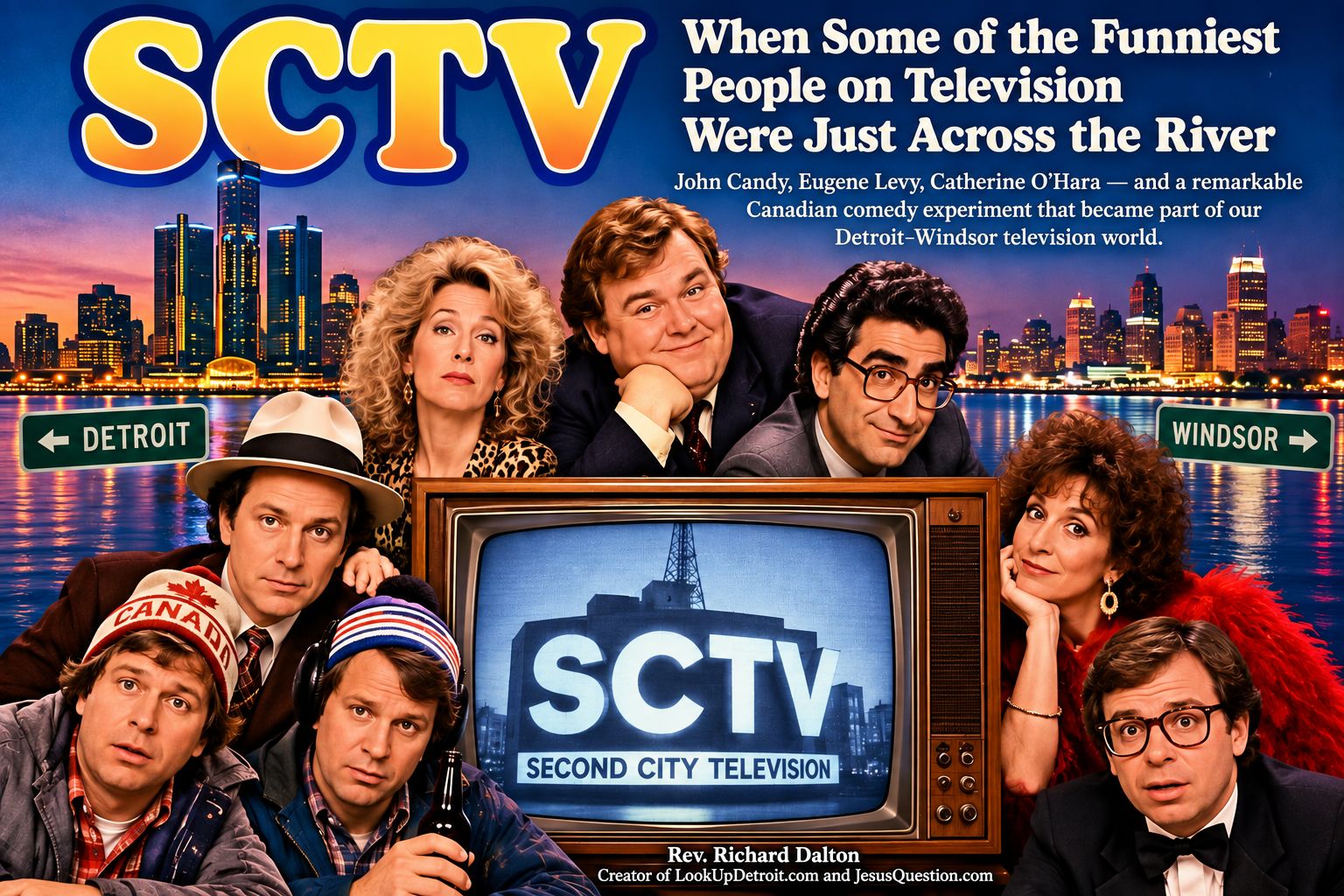
John Candy, Eugene Levy, Catherine O’Hara—and a remarkable Canadian comedy experiment that became part of our Detroit–Windsor television world
If you grew up around Detroit, you learned something that much of America never quite understood:
Canada wasn’t really somewhere else.
It was right there.
Look across the Detroit River and there was Windsor. Turn the radio dial and there was CKLW. Turn on the television and Canadian broadcasting was simply another part of the choices available to many Metro Detroit households.
That makes the story of SCTV — Second City Television — especially fun to revisit from Detroit.
The Little Television Station That Wasn’t Real
SCTV began in 1976 as an outgrowth of Toronto’s Second City comedy company.
The premise was wonderfully simple: instead of presenting disconnected comedy sketches, the performers created an entire fictional television station in the equally fictional town of Melonville.
Then they showed us what this wonderfully dysfunctional station supposedly broadcast.
There were terrible movies, local newscasts, talk shows, commercials, children’s programs, celebrity interviews and station executives who probably should never have been allowed near a television transmitter.
It provided a framework that allowed SCTV to make fun of television itself.
And what a collection of talent they had.
The original ensemble included John Candy, Eugene Levy, Catherine O’Hara, Joe Flaherty, Andrea Martin, Dave Thomas and Harold Ramis. (Broadcasting History)
Later, performers including Rick Moranis and Martin Short joined the SCTV universe.
Think about those names for a moment.
John Candy would become one of the most beloved comedy actors of his generation.
Eugene Levy and Catherine O’Hara would remain major comedy figures for decades.
Harold Ramis went on to help create films including Ghostbusters and Groundhog Day.
Martin Short and Rick Moranis became enormously recognizable performers.
Yet there they were, together, experimenting with television.
Johnny LaRue, Count Floyd and Edith Prickley
Part of SCTV’s genius was that its performers didn’t merely impersonate celebrities. They created characters who seemed to have entire lives inside this strange little television station.
John Candy gave us the magnificently self-important Johnny LaRue.
Joe Flaherty became station manager Guy Caballero, along with newsman Floyd Robertson and the unforgettable horror host Count Floyd.
Andrea Martin became leopard-print-wearing station executive Edith Prickley.
Catherine O’Hara created the wonderfully overdramatic entertainer Lola Heatherton.
Eugene Levy and Dave Thomas populated Melonville with still more characters, while Thomas and Rick Moranis eventually created perhaps SCTV’s most culturally famous duo:
Bob and Doug McKenzie.
“Take off, eh?”
Canada had arrived.
From a Small Canadian Show to NBC
SCTV’s beginnings were remarkably modest.
The program debuted on Canada’s Global Television Network on September 21, 1976. The early episodes were produced in Toronto. After disappearing for a period, the program returned through an arrangement involving CBC and moved production to Edmonton. (SCTV Guide)
Eventually the strange little fictional television station from Melonville made its way onto American network television.
In 1981, SCTV Network 90 began running on NBC as a 90-minute late-night program. (Broadcasting History)
That was quite a journey.
A Canadian comedy troupe had essentially created a parody of cheap local television—and that parody had become network television.
Detroit and Windsor: Television Without Much of a Border
There is another reason SCTV belongs in a LookUpDetroit conversation.
Detroit and Windsor have one of North America’s most interesting shared broadcasting histories.
Windsor’s Channel 9 began as CKLW-TV in 1954 and later became CBC-owned CBET in 1975. Canadian television from Windsor has long reached viewers throughout Metro Detroit and well beyond; CBET has been carried across significant portions of southern Michigan. (City of Windsor)
And, of course, anyone who remembers Detroit radio history knows the enormous influence of CKLW — “The Big 8.”
The river was an international boundary.
But radio and television waves didn’t pay much attention to it.
For generations, Windsor watched Detroit and Detroit watched and listened to Windsor.
That cross-border relationship helped give this region a media culture unlike almost anywhere else in America.
Look at What Came Out of That Little Television Station
There is something else about SCTV worth remembering today.
It wasn’t built around one enormous celebrity.
It was an ensemble.
People wrote together.
Performed together.
Created characters together.
Tried things that didn’t always work.
And apparently had enough freedom to be wonderfully strange.
From that environment emerged John Candy, Eugene Levy, Catherine O’Hara, Martin Short, Rick Moranis, Andrea Martin, Joe Flaherty, Dave Thomas and Harold Ramis.
That is an extraordinary amount of creative talent associated with one television program.
Perhaps that is part of what makes old SCTV clips so enjoyable today.
They remind us of an era when television could still feel a little homemade.
Before hundreds of cable channels.
Before streaming.
Before YouTube.
Before TikTok.
Before everybody carried a television studio around in his pocket.
A bunch of very funny people created a fictional low-budget television station called SCTV.
And somehow that little station in Melonville helped produce some of the biggest names in comedy.
For those of us in Metro Detroit, Canada was never very far away.
Sometimes all we had to do was turn the dial.
Rev. Richard Dalton
Creator of LookUpDetroit.com and JesusQuestion.com