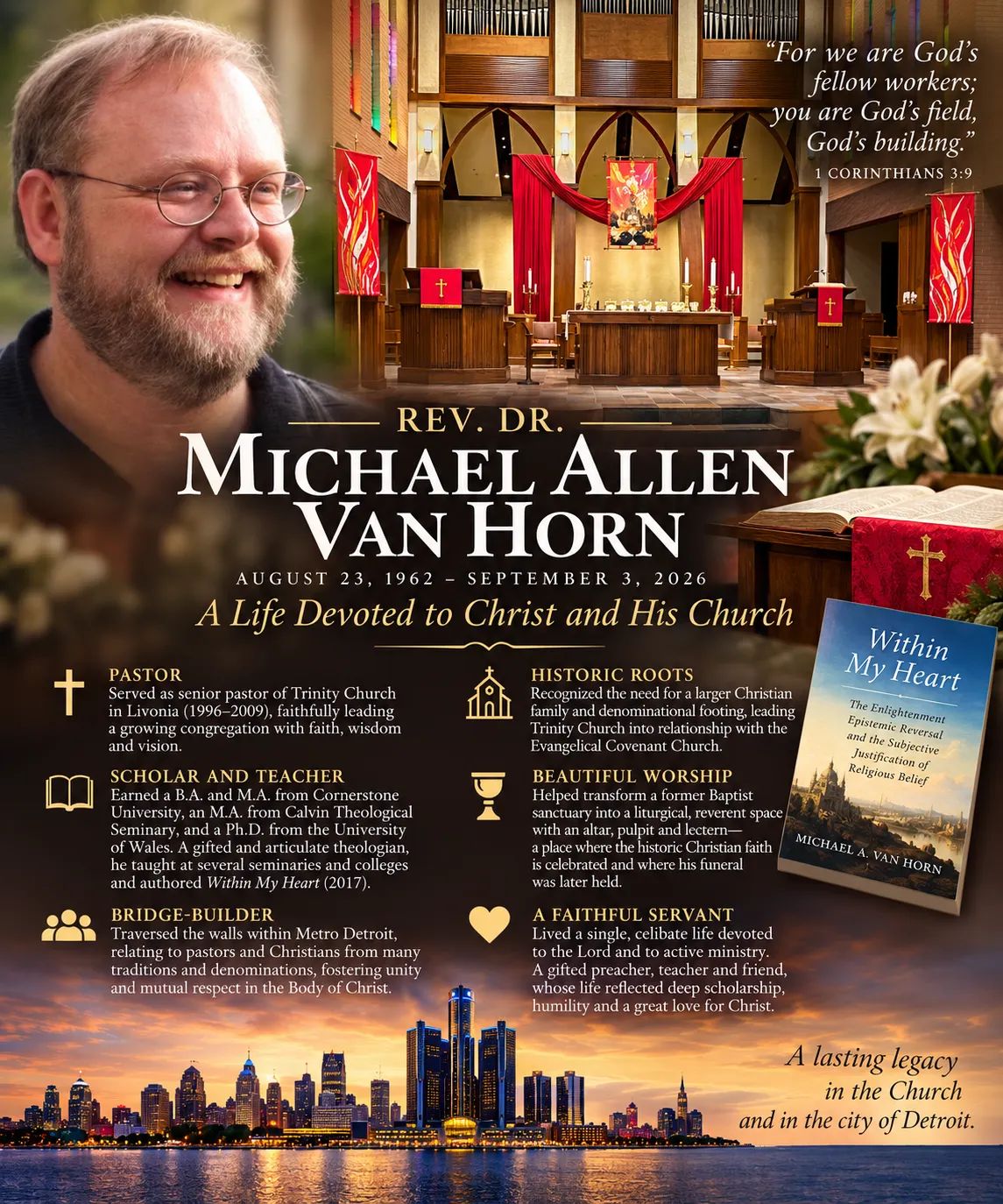
I am certainly no expert on the life and ministry of Rev. Dr. Michael Van Horn. In fact, I came to know Michael rather late in his life.
By then, Michael was in a wheelchair. His physical limitations were considerable, and communicating with him could be very difficult. I knew that behind those limitations was a man who had experienced a significant life of ministry, but I knew relatively little of that story firsthand.
My wife, Theresa, and I are members and make the hour long trip to His Church Anglican in Livonia, Michigan a couple times a month. We worship in the building that had previously been home to Trinity Church, where Michael served as pastor for many years. I knew enough about that history to have a high regard for Michael and to appreciate that he had played an important role in the story of the place where Theresa and I now worship.
Michael died on September 3, 2026. His funeral was held at His Church Anglican on September 15—the same day I was undergoing surgery. There was no possibility of my attending.
Still recovering from surgery, I was recently able to watch the funeral online. It was deeply meaningful to me because I began to discover more of the man whose later years I had witnessed.
Michael had chosen a single, celibate life devoted to the Lord and to active Christian ministry. I learned again what an extraordinarily articulate and scholarly man he had been—a serious theologian, teacher and pastor.
One characteristic especially caught my attention.
Michael seemed to have an unusual ability to traverse the walls that Christians sometimes build between themselves. His ministry brought him into meaningful relationships with pastors throughout Metro Detroit from a variety of Christian traditions and denominations.
That means a great deal to me. I have spent much of my own ministry believing that the prayer of Jesus in John 17—that His followers might be one—is not something we can simply admire. We have to live it.
Michael apparently did.
I was also impressed by his recognition that a local congregation needs roots beyond itself. Trinity needed a larger Christian family, theological footing and denominational accountability. Under Michael’s leadership, the congregation became part of the Evangelical Covenant Church.
There was another visible expression of Michael’s appreciation for the historic Church: the sanctuary itself.
The building had been a Baptist church, with a sanctuary designed for that tradition. Under Michael’s leadership, it was beautifully transformed into a more liturgical worship space, with an altar, pulpit and lectern and a sense of reverence appropriate to historic Christian worship.
As I watched Michael’s funeral, that struck me powerfully. His funeral was being celebrated in the beautiful sanctuary he had helped shape. Today Theresa and I worship there as Anglicans. Michael could hardly have known all the chapters that would follow, but something he helped create continues to serve the worship of God.
I also witnessed the faithful friendship of Bill Garfield of His Church Anglican, who served Michael during those difficult later years. The pastor who had spent his life ministering to others had reached a season when he needed others to minister to him.
I knew Michael primarily as the man in the wheelchair.
Through his funeral, I was introduced to the scholar, preacher, pastor, bridge-builder and servant of Christ who had been there all along.
I wish I had known him better.
But I am grateful that I knew him at all.
Rev. Richard Dalton
Creator of JesusQuestion.com and LookUpDetroit.com