

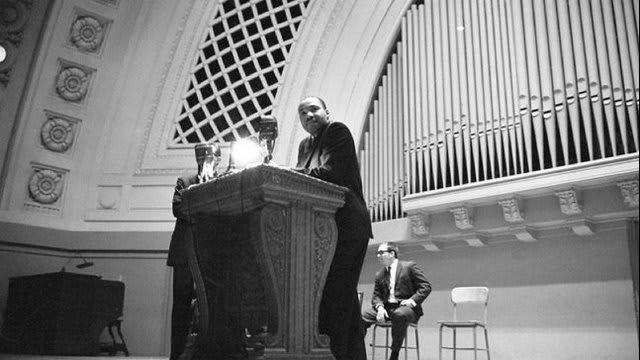
Less than a month before his assassination in Memphis, Martin Luther King Jr. made a quiet but meaningful visit to suburban Detroit—one of his final journeys outside the Deep South. While history most often remembers King’s last days through the lens of Memphis and the sanitation workers’ strike, his Michigan visit stands as a poignant reminder of how deeply his message resonated far beyond the places most associated with the civil rights movement. Detroit, with its own complex racial history, was fertile ground for King’s call to justice, reconciliation, and moral courage.
In an essay first published in the Detroit Free Press in 1974, Jude Huetteman, the Grosse Pointe activist who invited King, reflected on that final visit with clarity and humility. Huetteman recalled not a distant icon, but a weary yet resolute man—keenly aware of the danger surrounding him, yet unwavering in his commitment to speak wherever he was invited. The essay captures the personal dimension of the encounter, highlighting the trust King placed in local organizers who believed his presence could still move hearts in divided communities.
King’s stop in suburban Detroit underscored his conviction that racial justice was not merely a Southern issue, but a national moral crisis. Metro Detroit, marked by segregation, economic inequality, and the lingering trauma of the 1967 uprising, mirrored many of the struggles King addressed across America. His visit affirmed that the work of justice required engagement in cities and suburbs alike, calling individuals of conscience—especially white allies—to step forward and share responsibility for change.
Looking back, Huetteman’s recollection reads as both testimony and warning. Within weeks, King would be assassinated in Memphis, silencing one of America’s greatest prophetic voices. Yet his final visit to Michigan endures as a quiet chapter in that larger story—a moment when courage crossed geographic and social boundaries, and when one man’s invitation became part of a legacy that continues to challenge the nation to live up to its highest ideals.
