
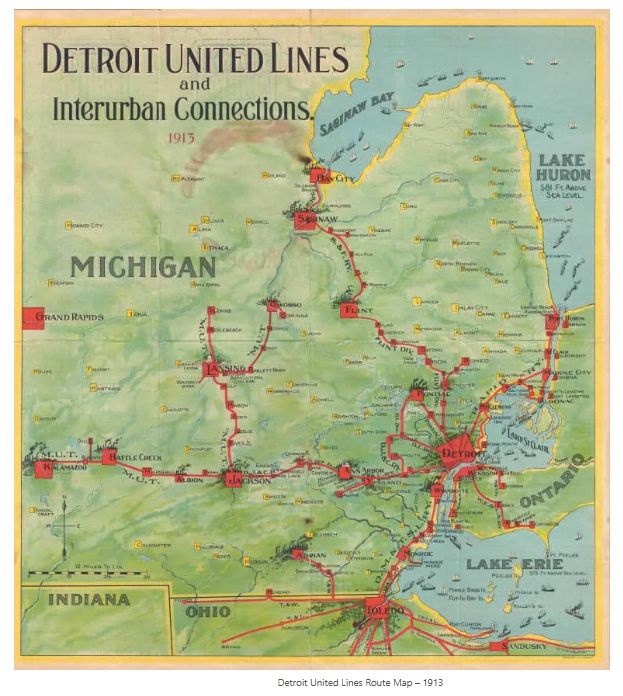
Before the age of freeways and automobiles, Southeast Michigan was connected by steel rails that carried not just passengers, but the very rhythm of daily life. The Detroit United Railway (DUR), formed in the early 20th century, became one of the most extensive electric interurban railway systems in the United States. At its height, it linked Detroit to Pontiac, Ann Arbor, Flint, Port Huron, and many smaller communities in between. These electric lines were more than transportation—they were lifelines that helped shape the growth and unity of Metro Detroit.
The DUR emerged in 1900 through the consolidation of several smaller streetcar and interurban companies. This unified system brought efficiency, expanded routes, and a sense of regional identity. Residents could travel from rural towns into the city for work, shopping, or entertainment, and return home the same day—something that had previously been difficult or time-consuming. The railway opened doors for economic opportunity, allowing Detroit’s influence to extend far beyond its city limits.
One of the remarkable features of the Detroit United Railway was its electric-powered cars, which were considered modern and clean for their time. These interurban cars often traveled on dedicated tracks between cities, reaching speeds that impressed early 20th-century passengers. Stations became community gathering points, and the regular rhythm of arrivals and departures helped define daily schedules. For many families, a ride on the DUR was not only practical but also a memorable experience.
The railway also played a key role in suburban development. Areas like Pontiac and other outlying communities grew more rapidly because people could live farther from Detroit while still maintaining access to jobs and services in the city. In many ways, the DUR helped lay the groundwork for what we now call “Metro Detroit,” connecting diverse towns into a shared economic and social region long before the freeway system existed.
However, like many interurban railways across America, the Detroit United Railway faced increasing competition from automobiles and improved road systems in the 1920s and 1930s. As cars became more affordable and highways expanded, ridership declined. By the late 1930s, much of the system had been dismantled or replaced by buses, marking the end of an era. Yet, the legacy of the DUR lived on in the communities it helped build and the patterns of travel it established.
Today, as Metro Detroit reflects on transportation and regional connectivity once again, the story of the Detroit United Railway offers both inspiration and perspective. It reminds us that strong connections between communities are essential for growth, cooperation, and shared prosperity. In its time, the DUR was more than a railway—it was a vision of a connected region, something that continues to resonate in new ways in our modern digital and physical public squares.
