
I love music.
In fact, I can play almost any instrument ever invented—as long as somebody else has already played it and I can stream it or play the MP3.
Put a violin in my hands, and you are taking your chances. Give me a recording of Itzhak Perlman, however, and I can have beautiful violin music filling the room in seconds.
I have come to accept that this may be my particular musical gift.
There is another problem. I have almost no sense of rhythm.
This becomes especially apparent in church when everyone begins clapping along with a song. Somehow an entire congregation can discover the beat almost instantaneously. Hundreds of hands come together at precisely the right moment.
And then there are mine.
I start confidently enough. For perhaps three claps I think I have it. Then somehow the congregation and I begin moving in different directions. I try to make a correction, which generally makes matters worse. Eventually I quietly retire from the percussion section.
I wish it weren’t so.
But apparently hand-clapping is not my place in the choir.
Barney Fife Finds His Calling—or Doesn’t
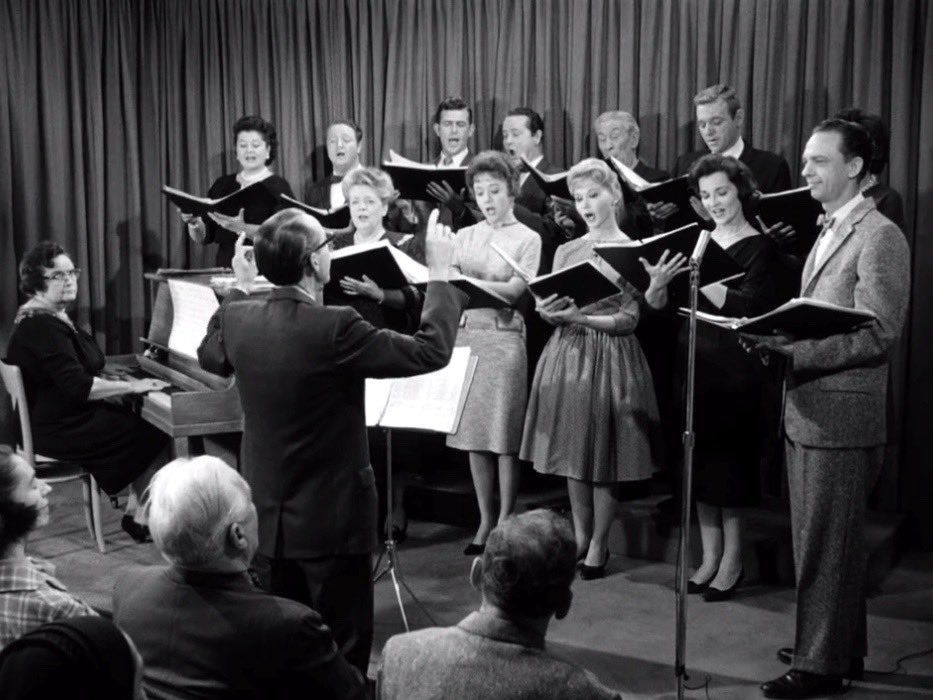
That brings me to one of my favorite pieces of television comedy: The Andy Griffith Show episode “Barney and the Choir.”
Mayberry needs a tenor, and Barney Fife is quite certain that he is just the man for the job.
There is only one problem.
Barney can’t sing.
Everyone seems to recognize this except Barney.
That is what makes the episode so funny. Barney isn’t timidly wondering whether he might be able to contribute. He has considerable confidence in his musical abilities.
Andy, as usual, tries to solve the problem without humiliating his friend. The result is an elaborate arrangement allowing Barney to believe that the beautiful tenor voice everyone hears is his own.
It is classic Mayberry.
But underneath the comedy is a surprisingly important lesson:
Barney has an important place in Mayberry. It just isn’t every place in Mayberry.
He is Andy’s friend. He is a deputy. He is loyal, enthusiastic and occasionally courageous. Mayberry would not be Mayberry without Barney Fife.
But the town might survive without his tenor.

There is something wonderfully liberating about knowing both things: I have a place—and I don’t have to occupy every place.
Let the Pig Be a Pig
I recently became fascinated with farmer Joel Salatin and his approach to agriculture at Polyface Farm.
One of the ideas running through Salatin’s thinking is remarkably simple: allow animals to behave according to their nature.
Let pigs root.
Let chickens scratch and peck.
Let cattle graze.
Instead of treating a farm like a factory in which animals are merely production units, Salatin asks what happens when we allow the natural characteristics of each animal to become part of the agricultural system.
The pig does something the chicken doesn’t do.
The chicken contributes something the cow cannot.
Even insects, grasses, soil organisms and manure have their places.
Suddenly the farm begins looking less like a factory and more like an orchestra.
Or perhaps a choir.
That immediately brought to mind the wonderful Bill Staines song “A Place in the Choir,” popularly remembered by its opening thought that all God’s creatures have a place—some singing low and others higher.
That’s the beauty of a choir.
If everybody sang exactly the same note, it wouldn’t be much of a choir.
Harmony requires difference.
When Pigs Decide They Don’t Want to Be Pigs
And that led me in a rather strange direction—to George Orwell’s Animal Farm.
I realize Orwell was writing a political allegory, not a handbook on animal husbandry. But the comparison is irresistible.
The pigs gradually decide that being pigs isn’t enough.
They move into the farmhouse. They sleep in beds. They wear clothes. They drink. Eventually they stand upright and walk on two legs.

By the famous conclusion, the other animals look from pig to man and from man to pig and have difficulty telling which is which.
Something has gone terribly wrong.
The pigs aren’t content with their place in the community. They want somebody else’s place—and ultimately they want control over everybody else’s place.
That is almost the exact opposite of the Salatin farm.
Let the pig be a pig.
Let the chicken be a chicken.
Let the cow be a cow.
And perhaps:
Let Barney be Barney.
Just don’t put him on the tenor part.
St. Paul Knew Something About Choirs
There is an even deeper connection here.
Nearly 2,000 years ago, the Apostle Paul described the Church using the image of a human body.
“If the whole body were an eye, where would be the hearing?”
—1 Corinthians 12:17
The eye cannot say to the hand, “I don’t need you.”
The foot doesn’t become less important because it isn’t a hand.
Paul’s point is not that differences are unfortunate obstacles we should overcome. The differences are necessary.
We need one another precisely because we aren’t identical.
That runs against a powerful temptation in human beings. We compare ourselves constantly.
Why can’t I do what he does?
Why isn’t she more like me?
Why wasn’t I given that ability?
Sometimes we even spend enormous energy trying to turn ourselves into something we simply aren’t.
There is an important difference between developing our abilities and pretending we possess abilities God never gave us.
Barney Fife could have benefited from understanding the distinction.
So could Orwell’s pigs.
And so, occasionally, could I.
Finding Your Place
Perhaps there is wisdom in simply asking:
What is my place in the choir?
Not: Am I as important as somebody else?
Not: Why can’t I do everything?
But: What have I actually been given to do?
After many years of life, I know there are some things I can do reasonably well. There are things I have enjoyed enormously. There are ways I have been able to serve other people.
And then there is rhythmic hand-clapping.
Apparently God distributed that particular gift elsewhere.
I can live with that.
In fact, there is something freeing about it.
The world doesn’t need 8 billion tenors. It doesn’t need 8 billion farmers, preachers, mechanics, musicians, teachers or computer programmers. And a healthy community doesn’t require everyone to possess the same abilities, interests or temperament.
We need people who can sing.
We need people who can listen.
We need people who lead.
We need people who quietly serve.
We even need people who know when not to clap.
Maybe that is one of the great lessons hidden in a children’s folk song, an old television comedy, an innovative farm, a political novel and one rhythmically challenged music lover:
All God’s children really do have a place in the choir.
The challenge is not to sing every part.
It is to discover our part, appreciate the parts given to others, and together make something none of us could make alone.
As for me, when the congregation starts clapping, I may simply smile and listen.
After all, I’ve finally discovered my place in the choir.
And it isn’t in the percussion section.
Watch this Video
